
Roots & Callings: Week One in the Archives – Kristin Fuhrmann-Simmons
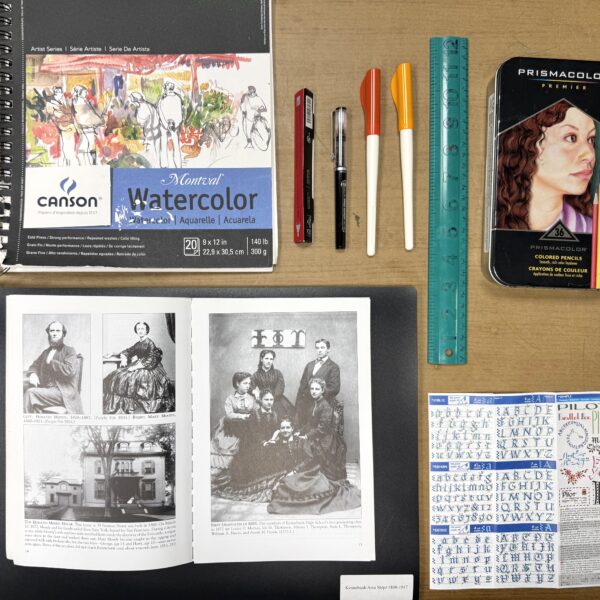
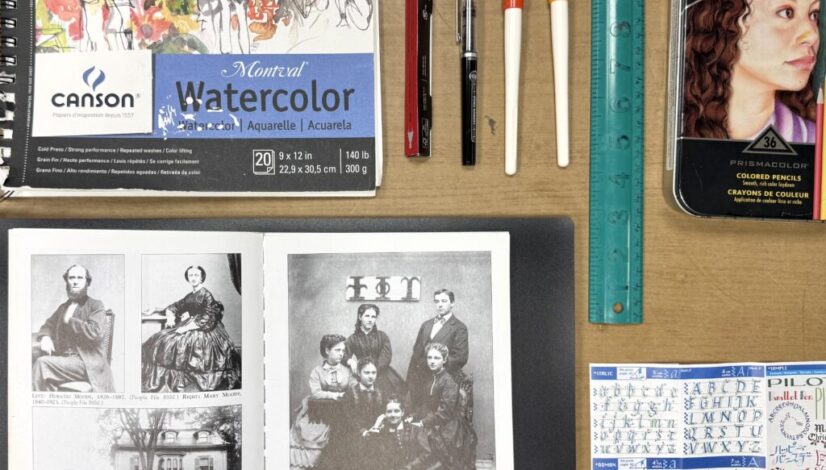
I’m so glad to be starting this summer as the Brick Store Museum’s 2026 Bauman Artist-in-Residence. Over the coming months I’ll be creating Roots & Callings: Family Histories of Kennebunk, a series of illustrated watercolor family trees inspired by the photographs, letters, deeds, ship logs, and other materials held in the Museum’s collections. It’s a project that lets me bring together genealogy, local history, watercolor, hand lettering, and storytelling to explore the people and families who helped shape this community.
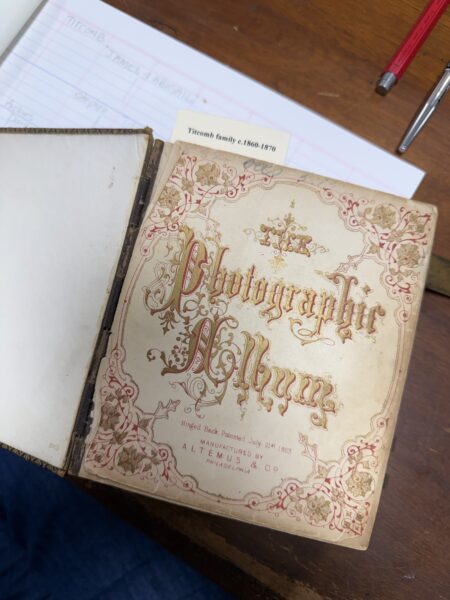
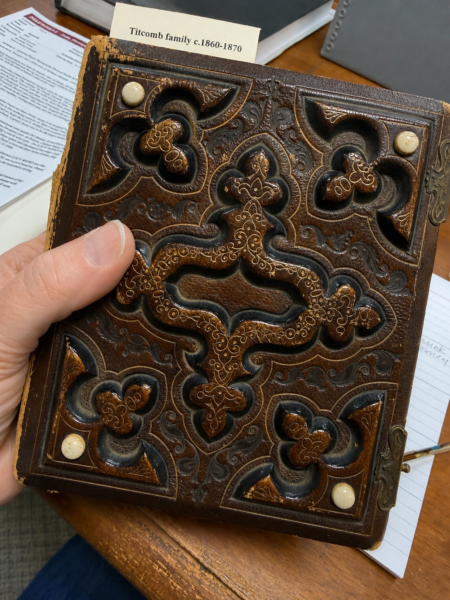
I spent my first week in the archive, and the work has already taken me somewhere I didn’t quite expect. I started with two threads: the Titcomb family of shipbuilders, and the diaries of Andrew Walker.
The Titcomb materials open a window onto the mechanics of a working coastal town: deeds, inventories, ship logs, photographs, and drawings that trace how one family’s labor and enterprise helped build Kennebunk’s maritime economy across generations. Walker’s diaries offer something more intimate, the daily texture of a life lived alongside that industry, in his own words.
Read together, the collection does what family history so often does. It gets specific. Names, dates, cargo manifests, a signature on a deed. But that specificity is exactly what surfaced the harder story underneath.
Sitting With the Paradox
Kennebunk’s shipbuilding prosperity didn’t rise in isolation. It rose alongside, and in some cases directly from, the displacement of the Wabanaki people from this land, and from an Atlantic trade economy built on enslaved labor. At the same time, many of these same families and this same community were shaped by a Christian moral tradition that publicly championed abolition.
That contradiction isn’t a footnote to this project for me, it’s part of what the project is about. A family tree looks like a simple, orderly thing: names branching outward, generation by generation. But the archive makes clear that prosperity and harm were often braided together in the same households, sometimes in the same decade, sometimes held by the same people who believed themselves to be acting rightly. Illustrating these family histories means finding a way to hold both truths on the page at once, without smoothing either one away.
I’m thinking a lot right now about how to let that paradox live in the work itself, rather than resolving it into something tidier than it was. The family-tree form is part of what makes this hard, it implies order just by its shape. Clean branches, tidy generations, a structure that reads as harmonious simply because it’s symmetrical. I don’t want that.
A few things I keep coming back to as I sketch out how these pieces might actually work:
I don’t want a color palette that quietly sorts people into “good” and “bad” branches, warm tones for the prosperous lines, something cooler and more distant for the harder parts. That’s a shortcut, and it lets the viewer off the hook too easily. It was one bloodline, one household, often the same hands doing both. I think the more honest choice is to let the same palette move across the whole piece, so nothing is pre-sorted for the eye.
Some of what’s missing from these records may end up rendered as literal absence rather than invention: the enslaved people rarely named as producers of the cotton that the Titcomb family shipped from New Orleans to Europe; a land “purchase” with no corresponding Wabanaki sale on record. Rather than filling those gaps, I’m drawn to creating them as alternately illustrated branches in the composition. The gap becomes part of the family tree, too.
I also want to let the archive speak for itself where I can. A single line of period language, lettered directly from a deed or lifted from Andrew Walker’s diary, can hold more than a paragraph of my own explanation would. It asks the reader to sit with the words themselves instead of being told what to think about them.
This week was groundwork, the kind of reading and note-taking that happens before a single brushstroke. I’m letting the material lead, following the Titcombs’ deeds and Walker’s diary entries where they actually go, rather than the story I might have expected to find going into this project.
What’s Ahead
In the coming weeks, I’ll start translating these findings into watercolor, illustrated genograms that trace lineage, labor, land, and belief across generations of Kennebunk families. I’ll be sharing process notes, archival finds, and a closer look at the people whose stories are emerging from the collection.
And mark your calendars: on September 23, I’ll lead a hands-on workshop inviting community members to research and illustrate their own family histories using this same watercolor genogram approach. More details to come.
Follow along this summer as Roots & Callings takes shape, right here on the blog, and in the galleries of the Brick Store Museum.